Showing posts with label the writer's life. Show all posts

Friday, September 16, 2022

The Writer's Life: How Waiting to Be Picked for a Team at Recess Prepared Us


by Crystal Bowman

Pick Me!

Most of us can remember standing in a group of kids on the playground as the two best baseball players chose kids to be on their teams. I remember my heart pounding, my stomach churning, and my self-esteem hanging on the line as I waited to be chosen for the game at recess. Once I was chosen first, and one time I was chosen last. Most of the time I was somewhere in the middle.

Sunday, December 27, 2015

Setting Goals for Your Writing Career

by Brenda McGraw @BrendaMMcGraw

Setting Goals for Your Writing Career
I hope you had a very Merry Christmas. Can you believe it is the end of another year?

How did you do with your goals and plans this year?

The end of the year is the time to evaluate the current year 2015, before heading into 2016, so we can begin with a fresh start.

Sometimes this can be difficult. We can make excuses of what we didn’t get accomplished or we can resolve to execute the plans we will accomplish the upcoming new year.

Saturday, October 24, 2015

Write with Abandon

So often with pick our writing to pieces before it has time to mature. This post and quote from Alton Gansky reminded me that there is a proper order to things. 

"Write with Abandon, Edit with Discipline." -Alton Gansky


Be sure to share your thoughts in the comments section below.

I invite you to use this image any way you like online. Post it to your blog, share it on Facebook, Twitter, Pinterest, anywhere you'd like. All I ask is that you keep it intact, with my website watermark visible.

Don't forget to join the conversation!
Blessings,

Friday, September 25, 2015

Write Hard and Pray Harder

by Lori Hatcher @LoriHatcher2

Jackie lives a charmed life. Writing opportunities fall into her lap, she wakes up with creative thoughts, and she always seems to be in the right place at the right time when publishers are looking for a new project.

Seth is the same way. Big name bloggers invite him to guest blog. Focus on the Family magazine calls him for article ideas, and people line up to promote his book. Like a modern-day Midas, everything he touches goes viral.

Other writers, however, sing the chorus of the old Hee Haw song about bad luck.

Tuesday, June 16, 2015

Tips for the Distracted Writer

by Lucinda Secrest McDowell @LucindaSMcDowell

How well I remember hearing the phrase, "Interruptions are my ministry!”

At the time I was on the staff of a large church and I totally got it—at any given time I was called up to meet with a parishioner or counsel a walk-in or fill in for another teacher. I was also mothering four young children and learning that key parenting moments occur when there's a knock on the bedroom door or a phone call from school or a simple cry of "Mama....." from another room.

In all those cases it was the distractions from my immediate task that propelled me to an even more important task. I get that.

However, distractions for the writer rarely lead to a more important task. Real writers know that writing is hard work. There is always, always, always something more enticing or immediate or tempting to see or read or do.

But that won't get the manuscript written or the research completed.

When I'm distracted in my writing I turn to these 5 helpful tips:

1. Unplug. Yes, you heard me right. Type on a computer that is NOT connected to the internet. Turn OFF your cell phone. And unplug the cord of your landline phone, if you happened to be one of the few who still has one. What you will discover (after fidgeting for awhile) is that it is much easier to focus on writing when you are not constantly checking in online with every vibration, beep or trill.

2. Set small goals. I'm much more productive when I have a plan. That small goal might be to write the opening paragraph. Or it might be to finish a whole chapter. Many writers set a goal of a certain number of words written for a time period. The guideline is to have a plan and then do it. When that work is finished, take a break. You will feel a sense of accomplishment, which will encourage you for the next small goal.

3. Go away. If you are able to leave your place of primary responsibility and write for a time at another place where you have few or no responsibilities, you will find many less distractions (well, unless it's a seaside resort at which point all bets are off). During the intense creative process of putting a new book together I will often housesit for a friend way out in the country. All I have to do there is think, pray, focus and write. Yes, it's a luxury but often works with trading places or perhaps renting during the off  season.

4. Take a break. If someone you love is in a crisis and you need to touch base or if the bills are overdue or there is something hanging over your soul that refuses to let go, then take a break and deal with it. Call the person. Pay the bill. Take a walk and ask God to help release you from the nagging concern. Be open to the fact that it might be the Holy Spirit nudging you to do something. Then, return to your writing.

5. Pray. I listed this last, but I actually use it first as my 'go to' response to distractions. Here is one of my favorite prayers in such a situation:

Celtic Prayer for Spiritual Concentration
“God, help my thoughts! They stray from me, setting off on the wildest journeys. My thoughts can cross an ocean with a single leap. They can fly from earth to heaven and back again, in a single second. They come to me for a fleeting moment, and then away they flee. No chains, no locks can hold them back. No threats of punishment can restrain them. Dear holy Christ, who can see into every heart and read every mind: Take hold of my thoughts. Bring my thoughts back to me and clasp me to Yourself. Amen."

I sincerely hope you are having a productive summer of writing, even as you take a break and read this blog. Full confession: I have enjoyed the "distraction" of writing my monthly offering for "The Write Conversation" but now I have to get back to the task at hand—one more chapter on my manuscript before supper break!

TWEETABLES
Life happens - @LucindaSMcDowel offers 5 tips for the Distracted writer on @EdieMelson (Click to Tweet)

Meeting #writing deadlines can be tough, tips form @LucindaSMcDowel on @EdieMelson (Click to Tweet)

Lucinda Secrest McDowell, M.T.S., is the author of 11 books, contributing author to 25 books, and has published in more than 50 magazines. A graduate of Gordon-Conwell Theological Seminary and Furman University, she studied at the Wheaton Graduate School of Communication and served as Communications Specialist for the Lausanne Committee for World Evangelization (Thailand) and Editor for Billy Graham’s International Conference for Itinerant Evangelists (Netherlands). A member of Advanced Writers and Speakers Association (AWSA), she has received “Writer of the Year” awards from both Mt. Hermon and Blue Ridge Writers Conferences. Cindy speaks internationally through her ministry “Encouraging Words” and co-directs the New England Christian Writers Retreat. Known for her ability to convey deep truth in practical and winsome ways, she writes from “Sunnyside” cottage in New England. Visit her online at www.EncouragingWords.net 

Tuesday, June 2, 2015

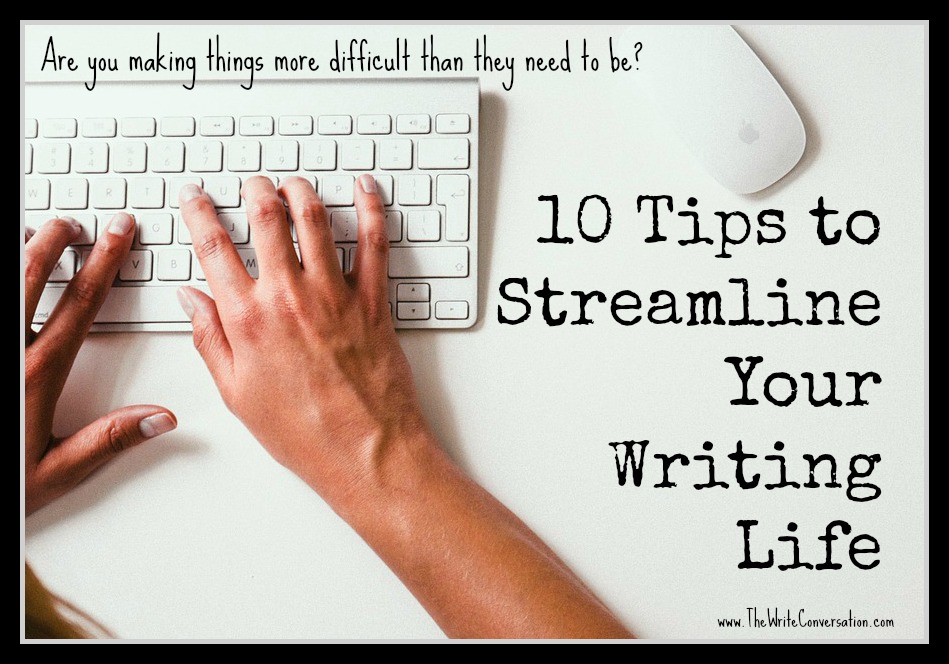
Tips to Streamline Your Writing Life

by Edie Melson @EdieMelson

10 Tips to streamline your writing life.
So often we make things harder than they have to be. Sometimes we do it because we’re used to doing things a certain way, or because it’s the only way we know how. But things change quickly these days, and it’s always a good thing to take a look at your routine with a fresh eye. Today I’m going to share some tips to streamline your writing life. Some you may already do, some you may not have ever considered. Just take a look at the list with an open mind and see if there’s anything on it that can make your life easier.

Thursday, May 14, 2015

The Myth of the Suicidal Writer

by Warren Adler @WarrenAdler

Looking at the long list of writers who have committed suicide, one is tempted to associate the so-called artistic temperament, the agony of creative achievement, with the primary motivation for that final act.

The list is long and includes many well-known literary figures like Earnest Hemingway, Richard Brautigan, Louis Adamic, Romain Gary, Sylvia Plath, Arthur Koestler, Primo Levi, Ross Lockridge Jr., John Kennedy Toole, David Foster Wallace, Virginia Woolf, Jack London Stefan Zweig, Raymond Chandler and Hunter Thompson among others.

Those who tend to associate the internal struggles of the creative life with suicide often concoct reasons based on romantic, legendary assumptions that making art requires a private agony based on a God-given talent that forces its possessor to see and feel more than ordinary mortals.

The myth contends that because the artist is blessed with such extraordinary insight, he or she can see into deeper truths where there is only futility, darkness, disillusion and death. It is all part of the tortured artist stereotype.
I'm not entirely sold. Granted, the gift of talent is mysterious and for lack of better definitions, God-given or gene-driven. Its development and flowering requires grueling work, deep discipline and ferocious dedication.

Writers of fiction, of which I am a practitioner, spend a lot of time creating parallel worlds in which characters interact and pursue experiences that are activated within the mind. These worlds are based on the writer's own experiences, hearsay and an amalgamation of memories, observations and ideas scrambling around in the imagination, all willfully whipped into order in a story format that seeks to find truth out of this muddle.

It is hard to convey the difficulties required to create fiction whether in the form of a novel, play or short story. It requires long hours of deep thinking and is a time-consuming and lonely effort of physical and mental labor to write and rewrite, ponder and argue with one's muse on how best to render a story. It is, indeed, a profound exercise difficult to explain as a process except to like-minded people engaged in such a pursuit.

It's easy to attribute a breakdown or a wish to escape from such a difficult and mysterious process. There have been many false romantic notions created by those who do not share these singular human talents. Some might conclude that one motive for suicide might be that the well has run dry, and the writer has reached the end of some mythical creative journey that has taken them to the edge of an equally mythical cliff, leaving the sole option of jumping into oblivion.

This so called "well run dry" theory has a long history and offers a satisfying explanation. It can't be rejected completely. For writers and all artists, the creative impulse is the oxygen that sustains them, and the possibilities of its perceived loss is consequential and could very well spark end of life thoughts.

Then there is the theory of the failed writer, those who believe in their talent and creations, yet are repeatedly rejected and, out of frustration and failure, take their own life. John Kennedy Toole seems to be an example of that category. His literary recognition came after his suicide by his mother's efforts to get his work published.

Perceived failure has long been a motive for suicide. But doesn't that apply to anyonewho is unable to cope with unfulfilled dreams? Strangely, there is the case of Ross Lockridge, Jr. who authored the well-received novel Raintree County. Favorably compared to Gone With the Wind, it was made into a movie with the two reigning stars of the day, Elizabeth Taylor and Montgomery Clift. Any creative writer would consider this a home run. Not Mr. Lockridge. He shot himself on the eve of the movie's release after the novel's long run on the New York Times bestseller list.

But there are many wonderfully creative and successful writers, Shakespeare may be a pinnacle example, who seem to have decided to pack it in for other reasons. As they say, using the poker analogy, there is a time to hold and a time to fold.

The list of famous writers who chose the path of continuation of their creative efforts or simple retirement is far longer than those writers who snuffed out their lives through suicide, and many have engaged in a large spectrum of occupations and endeavors.
My own view is that the creative life offers both agony and ecstasy. Whether one is a writer, painter, composer or any other occupation where the gift of imaginary invention is required, one should accept their talent as a cause for celebration. The lucky possessor who discovers its power should accept the gift as long as it lasts. Sometimes it lasts a lifetime. Sometimes it flowers and wilts. As the poet Robert Herrick opines.

Gather ye rosebuds while ye may,
Old Time is still a-flying;
And this same flower that smiles today,
Tomorrow will be dying.

The underlying causes of suicide are complex and numerous. It is a human fault line and is not exclusive to artists.

What is your opinion? Does the creative life of a writer bring with it added stress and susceptibility? Be sure to leave your thoughts in the comments section below.

TWEETABLE

Does the writer's life bring added stress & susceptibility to suicide? @WarrenAdler on @EdieMelson (Click to Tweet)

Wednesday, February 18, 2015

When We Don’t Feel Like Writing

by Lynette Eason @LynetteEason 

What do you do when you don’t feel like writing? Gasp! Not feel like writing? Is that even a real feeling?

Um…yes. Unfortunately, it happens. At least to me. Don’t get me wrong. I love what I do. I adore my job and the flexibility it affords me. Believe me, I don’t take it for granted. But I don’t wake up EVERY SINGLE day thinking, “Oh boy! I’m just so excited, I can’t wait to hit the keyboard!”

For those of you who do this, we are not friends and you can go away.

Just kidding.

Sort of.

Thursday, January 29, 2015

The Working Writer—Don't Wait for the Mood to Strike to Write!

By Edie Melson @EdieMelson

I began writing like most of you did—as a creative outlet—a way to process the world around me. 

I kept diaries, started stories and books, played around with articles. But all of these efforts had one thing in common. They were written out of my own emotional overflow. When that overflow dried up, so did the words.

Wednesday, October 29, 2014

Take Time to Retreat, Relax and Rekindle

by Edie Melson @EdieMelson

This sign greeted us at the front door of the house we stayed
in for the Guideposts retreat at the Wainwright House property.
As I mentioned briefly on Monday, last week I was given an incredible gift. I was one of eleven women who won the 2014 TELL US YOUR STORY Guideposts contest. The prize? Spending an entire week at the Wainwright House with Guideposts editors and writers honing our craft.

Even though I got home late Friday night, it’s going to take me a while to process this amazing experience. So expect some future blog posts about what I’ve learned here.

Thursday, October 23, 2014

12 Key Differences Between Successful and Unsuccessful Writers

by Edie Melson @EdieMelson

As writers, we’re warned early on to avoid the trap of comparison. Each of us has a different path to success—and a different path to publication. These varying ways of living life as a writer aren’t good and bad or even better and best—they’re just different.

Today I want to encourage you to do just the opposite.

While we shouldn’t judge our value as writers by looking at one another. There are some comparisons that can make a difference between fulfilling our dreams or losing heart and quitting when success is just around the corner. These are some key differences between successful and unsuccessful writers.

Wednesday, October 15, 2014

The Writer's Life—Distractions

by Lynette Eason @LynetteEason

What is your distraction?

I don’t know about y’all, but two weeks sure does pass by fast for me. It gets me thinking how fast my kids are growing up, how fast that deadline arrives, how fast that opportunity came and left. Lately I’ve been thinking about time. How am I spending it? What are the results of how I’m using my time? We often talk about being good stewards of our money, but what kind of steward are we with the time the Lord has allotted for us? Yes, I’m preaching to the choir. LOL

Anyway, I know that I tend to take on more than I can handle sometimes. And sometimes the things that I say yes to might be GOOD things, but that doesn’t mean they’re the RIGHT things for me. Sometimes they become a distraction from the purpose I’ve been called to fulfill.

Friday, July 25, 2014

Remind Yourself of These Things Every Time You Sit Down to Write

By +EdieMelson  @EdieMelson

So often writers struggle more against the head-game part of the journey than any other. Today I’d like to share a list of things to help. So remind yourself of these things every time you sit down to write. 

You're welcome to use/share this graphic online, just be sure to link back to this site.
These are the things I hold onto when the doubts creep in. What would you add to the list?

Don’t forget to join the conversation!
Blessings,
Edie

TWEETABLES

Thursday, January 2, 2014

Are You Struggling With Your Writing? Let God Decide Where to Put You!

by Lynn H Blackburn

Several years ago, my dad made a beautiful mirrored coat rack. I had the perfect wall for it and it hung in a place of prominence in my home where it received oohs and ahhs from friends, family, and guests.

Then we moved.

Our new home has an open floor plan with short walls. Most of the long walls are full of windows. There isn't a single spot in the house that made sense for the coat rack. I guess I could have hung it in the dining room. It would've made a great conversation starter, but it also would've made it functionally useless.